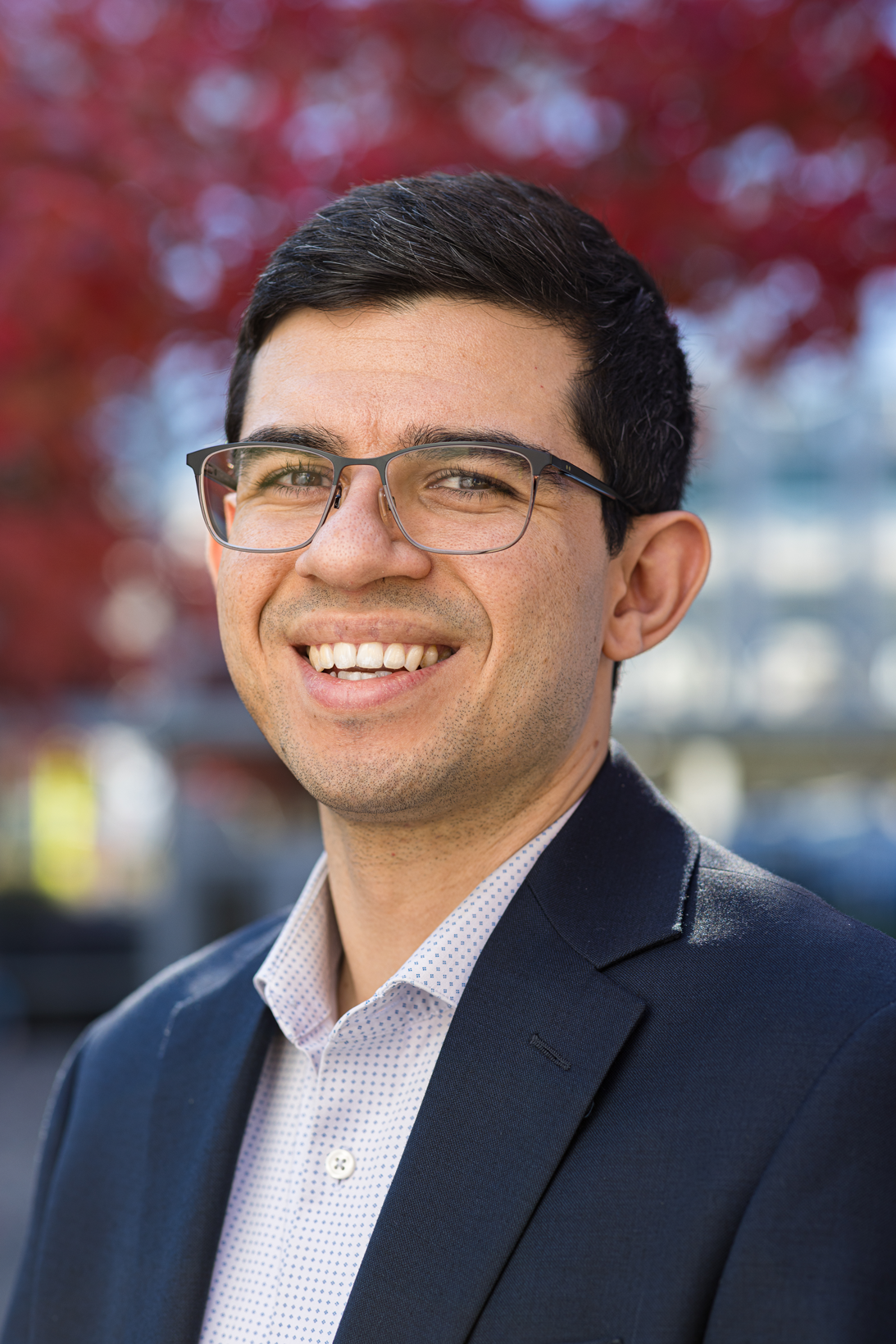
Seminar Abstract:
Electrocatalysis has the potential to enable sustainable chemical infrastructures via the generation of commodity chemicals such as hydrogen, hydrocarbons, and ammonia with renewable energy, but electrochemical devices such as electrolyzers often exhibit inadequate activity and stability for these transformations due to poor catalyst performance for the oxygen evolution reaction (OER). The Moreno-Hernandez Laboratory specializes in the design of electrocatalysts for next-generation energy devices via a multiscale feedback loop that integrates the precise synthesis of nanomaterials, atomic-scale observations of structural dynamics in liquid environments with in situ transmission electron microscopy, and the assessment of electrocatalyst performance under relevant operating conditions via proton exchange membrane water electrolysis. Insights from these activities, in particular with liquid phase transmission electron microscopy (LP-TEM), has resulted in the direct observation of electrocatalyst degradation mechanisms and degradation kinetics at the nanoscale, and the observation of collective atomic-scale mechanisms of dissolution. Disorder-induced degradation has been found to result in substantial nanoscale heterogeneity in dissolution properties for rutile-type electrocatalysts such as RuO2 and IrO2. Insights from these activities has resulted in the discovery of oxidized overlayer electrocatalysts with improved noble metal utilization, the discovery of experimental energy scaling relations that can guide catalyst design for non-iridium electrocatalysts, the direct observation of electrocatalyst degradation mechanisms at the nanoscale, and the observation of atomic-scale mechanisms of dissolution. Our studies highlight the importance of multimodal approaches to guide electrocatalyst design and motivate further study of nanoscale and chemical effects that can be harnessed to design efficient, earth-abundant, and stable electrocatalysts for electrochemical transformations.
Speaker Bio:
Prof. Ivan A. Moreno-Hernandez is an Assistant Professor in the Department of Chemistry at Duke University. Ivan received his B.S. degree in Chemistry and Physics with University Honors from the University of Nebraska-Lincoln in 2014, and his PhD degree as an NSF Graduate Research Fellow in Chemistry from the California Institute of Technology in 2019. His research at Caltech with Prof. Nathan S. Lewis focused on the study of earth-abundant materials for anodic reactions in acidic electrolytes. Ivan was a postdoctoral scholar from 2019 to 2022 in the Department of Chemistry at the University of California, Berkeley, working with Prof. A. Paul Alivisatos on the study of nanomaterials with liquid phase transmission electron microscopy. Ivan has a proven record in energy science and electrochemistry, being named a 35 under 35 Materials Scientist by Matter, a Scialog Fellow for Sustainable Minerals, Metals, and Materials, and a Scialog Fellow in Negative Emissions Science. His independent research has resulted in additional awards including an NSF CAREER award, an Early Career Distinguished Presenter award by MRS Communications, and an ACS Petroleum Research Fund Doctoral New Investigator award. In his independent career, Ivan’s research achievements include the development of methods to study the structural dynamics of electrocatalyst materials with in situ TEM techniques, and the discovery of materials that control activity towards electrocatalytic transformations via nanoscience approaches. Ivan’s independent work has resulted in research articles published in premier journals, including the Journal of the American Chemical Society, Matter, Energy & Environmental Science, and invited perspectives in the Journal of Physical Chemistry C and ACS Catalysis.