Seminar Abstract:
Photoexcitation can convert photon energy into chemically and electrically functional states, such as
proton-released ionic species, charge-separated states, and mobile free carriers. Understanding how
these states form and evolve is key to designing molecular and hybrid materials for photochemical and
optoelectronic applications. In this talk, I will present our time-resolved spectroscopic studies on three
classes of materials. First, in benzothiazole–thiophenol-based organic photoacids, tuning the acceptor
strength modulates photoacidity, and intramolecular charge transfer promotes excited-state proton
transfer in non-aqueous environments.[1,2] Second, in organic donor/acceptor systems, intermolecular
structural elements beyond covalent structure and energetic offsets govern the identity and dynamics
of photogenerated species.[3-4] Third, in halide perovskite nanocrystals, ligand length and structural
dimensionality determine whether photoexcitation yields isolated excitons or free carriers that migrate
between particles, leading to contrasting relaxation dynamics.[5] Together, these studies show how
molecular and structural design can direct the conversion of photon energy into functional protonic and
electronic states, and how time-resolved spectroscopy helps establish design principles for controlling
these pathways
Speaker Bio:
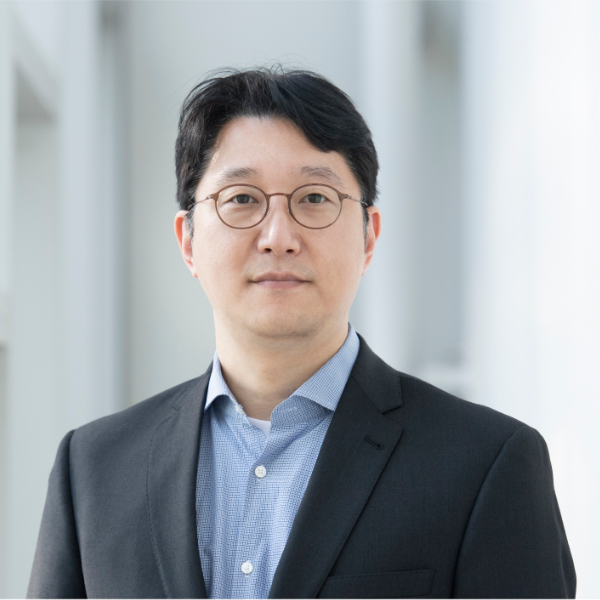
JaeHong Park, Ph.D. is an Associate Professor in the Department of Chemistry and Nanoscience at Ewha Womans University and the Institute of Multiscale Matter and Systems (IMMS). Dr. Park received his Ph.D. in Physical Chemistry from the University of Pennsylvania and conducted postdoctoral research at the National Renewable Energy Laboratory (NREL). Prior to joining Ewha Womans University, he held a faculty position at Kyoto University. He has authored over sixty peer-reviewed publications in leading journals, including Nature Communications, Journal of the American Chemical Society, and Advanced Materials. His research focuses on excited-state photophysics and charge-carrier dynamics in organic and inorganic semiconductor materials, with an emphasis on understanding how molecular structure and nanoscale organization govern exciton formation, charge separation, and energy conversion processes. His work combines ultrafast laser spectroscopy and advanced spectroscopic analysis to establish fundamental design principles for functional materials used in optoelectronics, energy conversion, and photochemical applications.