
On November 19, Colorado State University graduate students shared innovative research, creative artistry and entrepreneurial projects while competing for $24,300 in scholarships at the tenth annual Grad Show.
The event connected 295 presenters from all eight colleges and special academic units. Many chemistry graduate students presented their research at the showcase.
This year, five chemistry grad students were awarded first place prizes and two students received honorable mentions:
College of Natural Sciences – Outstanding Scholar Awards for $1,000 each
Megan Rothenberg, “Leveraging Multivalent Crosslinks in Dynamic Hydrogel Design”
Autumn Peters, “Neutralizing Electronic Defects with Vacancies in Hybrid Perovskites”
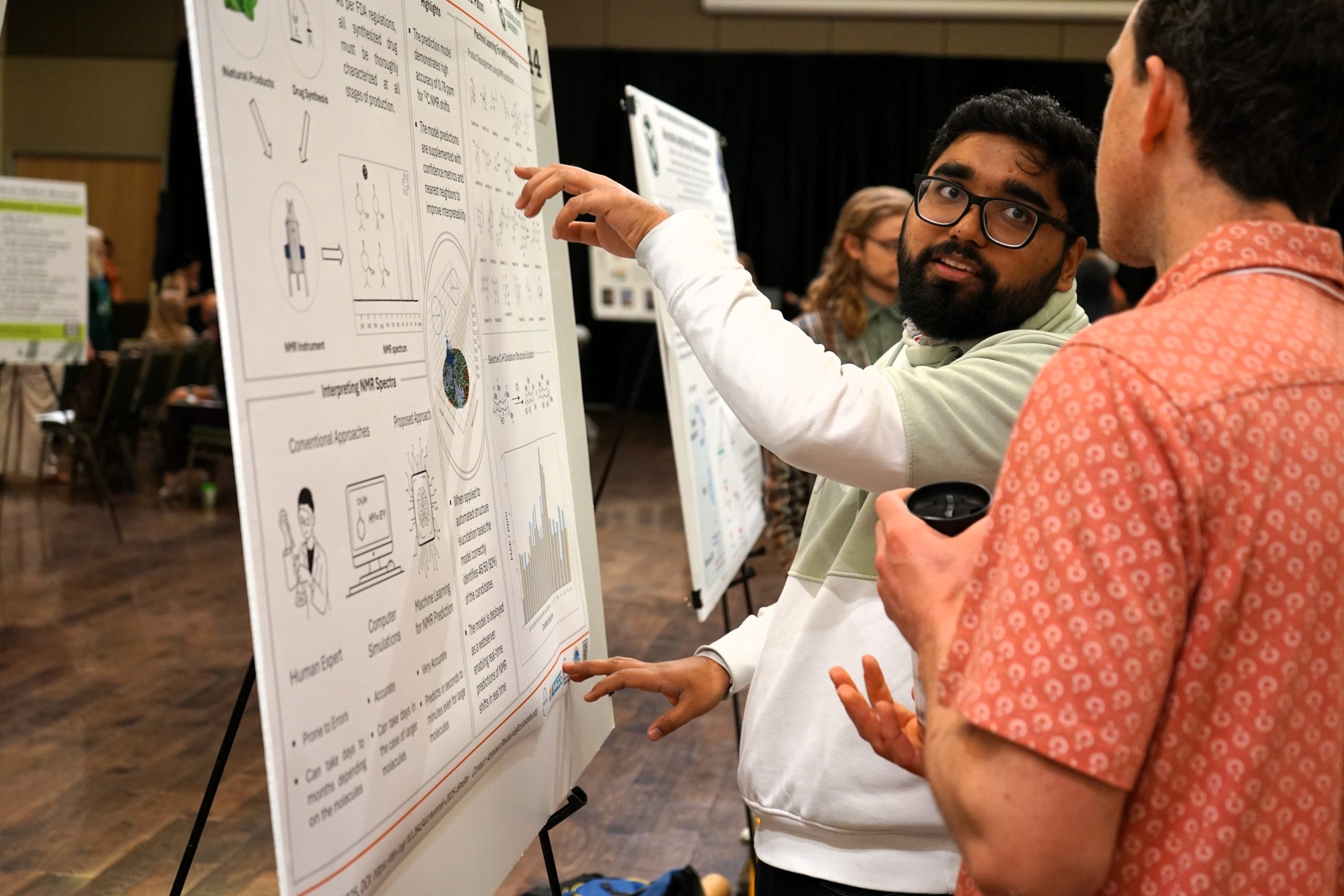
Abhijeet Bhadauria, “Real Time Prediction of 13C-NMR Shifts with sub-ppm Accuracy”
Analytical Resources Core – Analytical Excellence Award for $350
Ally Cunningham, “Effective Recycling Pathways of Commodity Polymers Enabled by Mechanoradical Capture”
Great Minds in Research: Presented by the Graduate School and OVPR – 1st Place for $250
Monika Perez, “Development of Zinc Antimonide Alloys for Sodium-Ion Batteries”
Great Minds in Research: Presented by the Graduate School and OVPR – Honorable Mention for $100
Ren Borgia, “Defect Resistance in Semiconductors: Novel Salt-Stabilized Synthesis of Cu2SiSe3”
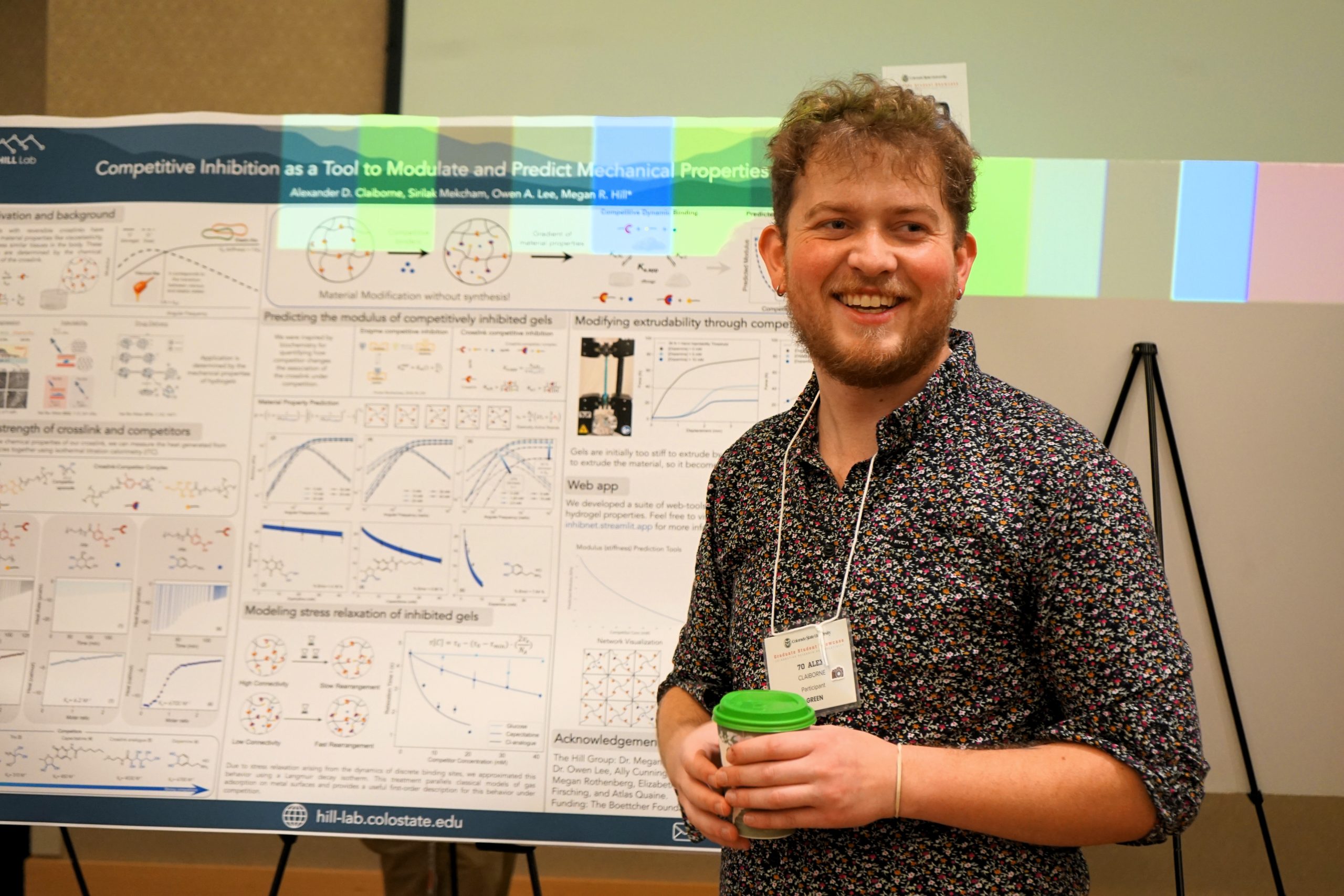
Alex Claiborne, “Competitive Inhibition as a Tool to Modulate/Predict Mechanics of Hydrogels”
This year’s Department of Chemistry winners shared the focus of their research:
Megan Rothenberg
My work focuses on designing an alternative synthetic crosslink architecture for dynamic hydrogels, inspired by the multivalent binding that occurs in biological systems. These modified crosslinks allow us to access to unique properties as a result of multivalency, leading to high value materials that can be used for drug delivery, tissue mimics, and more.
Autumn Peters
Hybrid organic-inorganic perovskites are a class of next-generation semiconductors that have reached commercialization in photovoltaic devices. Most of these materials are composed of lead, but tin-based materials offer a broader potential with reduced concerns from toxicity. However, the tin-based materials suffer from issues related to uncontrolled oxidation leading to low device efficiencies, in contrast to the commercialized lead-based devices. Atomistically, it is thought that tin vacancies charge compensate for this oxidation. Therefore, we ask the question: can intentional generation of tin vacancies in hybrid perovskite structures prevent this unintentional oxidation? By understanding the crystal chemistry and how chemical substitution within different positions in the crystal structure, we have understood how different chemical compositions influence this defect vacancy concentration. Using microwave conductivity experiments, we reveal how this compositional substitution reduces the propensity for uncontrolled oxidation. The intentional introduction of defects in these defect tolerant semiconductors presents a new approach to control electronic doping in next-generation semiconductors.
Abhijeet Bhadauria
In the work presented, we developed a Machine Learning based NMR shift prediction model capable of delivering highly accurate prediction within seconds. The model demonstrates capabilities to assist Chemists in NMR spectra assignments, selecting the revised assignment in several previously reported literature misassignments. Additionally, the model provides metrics and analyses to contextualize its predictions, rather than treating them as a black box. We hope the model will help the Chemists in the lab with their spectral assignments saving both precious time and effort in this regard.
Ally Cunningham
This research shows that damage caused during mechanical recycling—when plastic chains break and lose strength—can be turned into an advantage by capturing the reactive fragments and using them to rebuild the material. Using ball milling and a trapping agent, the authors successfully recycled polystyrene and PMMA by restoring or even improving their molecular weight and properties, enabling repeatable, value-preserving recycling cycles.
Monika Perez
My work focuses on developing alloying electrode materials for sodium-ion batteries. Currently, I am working on optimizing a zinc-antimony (Zn-Sb) alloy as an anode material. Antimony alone suffers from large volume changes when sodium is stored, but including another metal like zinc can help alleviate negative impacts of volume changes. Electrodes are prepared via electrodeposition, reducing the metals onto a current collector and from there we can evaluate the electrochemical performance of our materials. These materials display short cycle lifetimes due to pulverization of the deposited material upon sodium storage. One method to address this issue is including a structural additive to improve the chemomechanical properties of the electrode. Inclusion of these structural additives also alters the morphology of the deposited material. Future directions include evaluating the electrochemical performance of electrodes with structural additives and investigating the interface between the metal foil and deposited material.