About the seminar:
Carbenes are versatile reactive intermediates that display orthogonal reactivity to common nucleophilic and electrophilic functional groups. Catalytic carbene transfer reactions were first discovered over a century ago, and numerous examples of [n + 1]-cycloaddition reactions have since been developed, often with control over diastereo- and enanatioselectivity. Most of these reactions rely on the controlled decomposition of diazoalkanes as a central strategy to access reactive carbene equivalents.
Despite the utility of diazoalkanes in organic synthesis, they are inherently limited by the need for stabilizing substituents such as aryl or carbonyl groups. In order to develop transfer reactions of nonstabilized carbenes, it is necessary to consider an alternative set of precursors. Our group has shown that nickel and cobalt catalysts can promote reductive [n + 1]-cycloaddition reactions using readily available and indefinitely stable 1,1-dichloroalkanes and 1,1-dichloroalkenes as precusors for carbenes and vinylidenes, respectively. In this seminar, I will describe our development of new cycloaddition methods and our current hypotheses about the mechanisms of these reactions.
About the speaker:
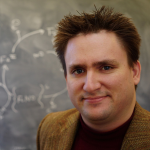
Professor Christopher Uyeda is the Herbert C. Brown Professor of Chemistry at Purdue University. After growing up in Vancouver, Canada, he attended Columbia University, where he earned his B.S. in biomedical engineering in 2005. As an undergraduate student, Chris carried out research on hydrophobically directed reactions with Prof. Ronald Breslow. Chris moved to Harvard University to pursue graduate research under the guidance of Prof. Eric Jacobsen. He obtained his Ph.D. in 2011, and his thesis described the development of catalytic enantioselective Claisen rearrangements using chiral hydrogen bond donors. Chris then carried out postdoctoral research with Prof. Jonas Peters at Caltech as an NSF Center for Chemical Innovation Fellow. His work involved studying molecular electrocatalysts for the production of solar fuels. In 2013, Chris started his independent career at Purdue University as an assistant professor. In 2019, he was promoted to associate professor with tenure and was promoted to full professor in 2022. Chris’s research program lies at the interface of organic and inorganic chemistry, and it focuses on the development of new catalytic reactions for the synthesis of fine chemicals, pharmaceutical compounds, polymers, and energetic materials. He is an associate editor for Science Advances and is the deputy director of the Department of Defense Energetic Materials Basic Research (EMBR) Center.