About the seminar:
Nanoelectrochemical tools, such as electrochemical microscopes, nanopore sensing, and nanoelectrodes, can address questions that are inaccessible to macroscale techniques. They allow one to measure faster processes and shorter-lived species, assess spatial heterogeneity of electrode surfaces, and by measuring individual nanoscale entities (e.g., nanoparticles), assess heterogeneity in a population. This has led to a deeper understanding of both electrochemical processes (e.g., electrocatalysis) and physical processes (e.g., nucleation).
Yet despite these advances, key experiments from the macroscale electroanalytical toolbox are presently inaccessible or infeasible at the nanoscale. For example, it is not feasible to characterize individual nanoentities or nanoscale regions with multiple solutions with a statistically relevant throughput. Yet, changing the solution composition is a powerful and commonly applied strategy with numerous applications. For example, one might decipher a reaction mechanism by measuring at different pHs, adding reaction intermediates, or inhibitors. Alternatively, one might electrodeposit an electrocatalyst and then characterize it in a different solution, studying how deposition parameters influence activity. Or more simply, one might wish to perform a background measurement and then measure at different analyte concentrations to deliver background subtracted current-concentration responses. This talk will describe our efforts to address this limitation through development of a species-switching scanning electrochemical microscope capable of measuring single nanoscale regions and entities under multiple solution conditions.
About the speaker:
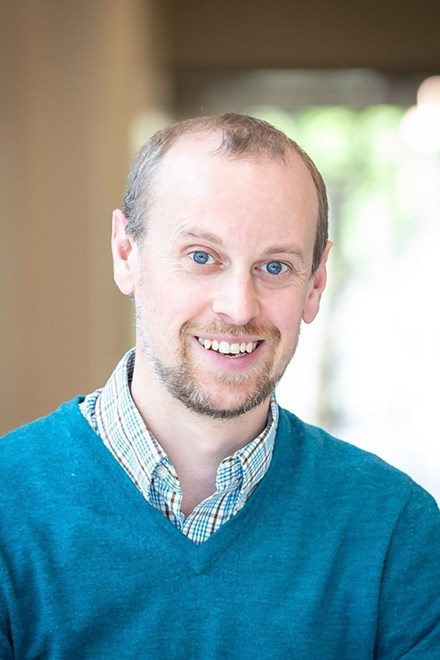
Martin Edwards is an assistant professor of analytical chemistry at the University of Arkansas, Fayetteville. His group’s research combines physical/analytical techniques with mathematical modeling to understand and manipulate diverse micro- and nanoscale phenomena. Using an approach that combines physical and analytical measurements with modeling (mathematical/statistical/numerical), he has tackled problems and answered questions in areas ranging from single-molecule bioanalytical measurements, through next-generation energy-storage technologies, nucleation, and electrocatalysis. A constant thread throughout his research is the development of novel instrumentation, experiments, and the frameworks for interpreting them. His work frequently involves the development or modification of scanned probe microscopes. He was the 2020 recipient of the Royce Murray Young Investigator award from the Society of Electroanalytical Chemistry (SEAC).