About the seminar:
The development of the next generation of functional materials, including optoelectronic devices, stimuli-responsive catalysts, separation platforms, and on-demand drug delivery platforms with tailorable properties, relies on rapid switching between two or more distinct forms in bulk solids. The current benchmark in the field of stimuli-responsive materials has previously achieved solution-like photoisomerization kinetics in the solid state. However, we present a fundamentally novel approach by far surpassing solution-like photoisomerization kinetics in the solid state through strategic engineering of the molecular environment. We showed that the constructed solvent-free pore environment led to a ~1,000-fold enhancement of the photoisomerization rate in the solid state even compared to one in solution, setting a record in the field. We employed this concept to develop field-effect transistors, photochromic catalysts, and “smart” absorbents. In this presentation, the established concept will be discussed in the context of developing stimuli-responsive heterogeneous catalysts that combine the potential for in situ regulation of the reaction parameter space with the enhanced recyclability of solid-state platforms. Specifically, the avenue toward noninvasive control of chemical reactivity via on-demand modulation of the metal oxidation state, establishing a new design principle for adaptive catalytic systems, is going to be demonstrated. Moreover, we expand a molecules-to-materials concept of adaptive photochromism toward selective metal capture with on-demand, stimulus-triggered release, driven by demands in nuclear medicine, critical metal recovery.
About the speaker:
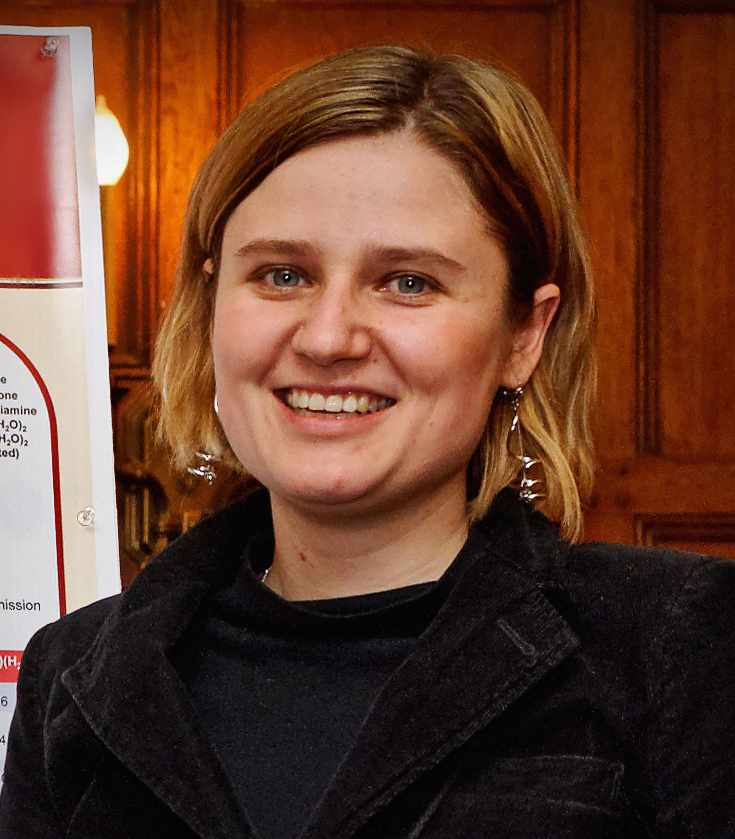
Natalia B. Shustova is a Fred M. Weissman Palmetto Professor in the Department of Chemistry at the University of South Carolina (USC). She holds Ph.D. degrees in Physical Chemistry and Inorganic Chemistry and completed her postdoctoral training at the Massachusetts Institute of Technology. Currently, she serves as an Associate Editor at ACS Materials Letters, following her term as an Associate Editor of Materials Chemistry Frontiers. Dr. Shustova is a recipient of international and national awards, including the Friedrich Wilhelm Bessel Research Award from the Humboldt Foundation, IAS Hans Fischer Fellowship, the National Science Foundation Career Award, the Cottrell Scholar Award, the Alfred P. Sloan Research Award, the Breakthrough Award, the McCausland Fellowship, Breakthrough Award, the Camille Dreyfus Teaching-Scholar Award, SC ACS Outreach Volunteer of the Year, and Distinguished Research Service Award. Dr. Shustova was named a Scialog Fellow of the Research Corporation for Science Advancement (RSCA), which accelerates 21st-century transformational science through research, dialog, and community outreach. She also serves on the RSCA Selection Committee, which assesses the research and educational performance of Assistant Professors across institutions in the USA, selecting the next generation of candidates for the Cottrell Scholar Award. She is a member of the executive committee of the Arnold and Mabel Beckman Foundation and also serves as Chair of the International MOF Committee, comprising 14 scientists from eight countries. Her current research interests include graphitic hybrid materials for sustainable energy conversion, the chemistry of f-block elements, smart sorbents, stimuli-responsive optoelectronics, sensors, and gas-phase/solution heterogeneous catalysts.