Seminar Abstract:
Atmospheric N2 is a cheap, abundant resource with great potential for energy storage and chemical synthesis, but it is difficult to convert it into other compounds (“fixing” nitrogen). This seminar will describe the challenges and opportunities of nitrogen fixation, as well as my students’ discoveries of how to break the N–N bond of N2 using homogeneous transition-metal complexes. In addition to new catalysts for producing ammonia, we have identified a new mechanism for sequential C-H activation and N-N activation to create C-N bonds. Detailed mechanistic studies reveal a cyclic reaction, which gives a route from atmospheric N2 and petroleum-derived arenes to substituted anilines. This is an important step toward preparing useful chemicals using air as a starting material.
Seminar Bio:
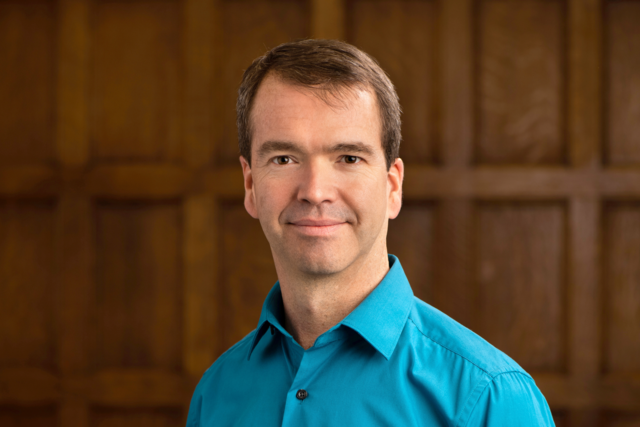
Patrick Holland trained at Princeton University (A.B. 1993), University of California at Berkeley (Ph.D. 1997 with Robert Bergman and Richard Andersen), and University of Minnesota (postdoc 1997-2000 with William Tolman). Prof. Holland is now Whitehead Professor of Chemistry at Yale University. His independent research at the University of Rochester and later at Yale has encompassed iron-nitrogen chemistry, metal-ligand multiple bonds, iron-sulfur clusters, engineered metalloproteins, redox-active ligands, solar H2 production, and mechanisms of catalysis with Earth-abundant metals. His research has been recognized with a number of awards, and election as a Fellow of the American Association for the Advancement of Science.