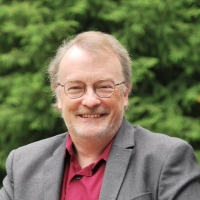
THE 2025 JOHN K. STILLE SYMPOSIUM - FRONTIERS IN ORGANIC CHEMISTRY
The 11th Stille Symposium will be held at Colorado State University on April 26, 2025. Four world-renowned scientists, Tehshik Yoon (University of Wisconsin); Alison Wendlandt (MIT); Mookie Baik (Korea Advanced Institute of Science and Technology), and James McCusker (Michigan State University) will be giving lectures.
Questions or Comments? Please contact us at CHEM_stille@mail.colostate.edu.
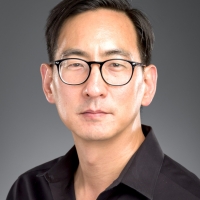
Tehshik Yoon – “Stereocontrol in Photochemical Synthesis”
University of Wisconsin
Tehshik Yoon is a Professor of Chemistry at the University of Wisconsin–Madison, where he has served on the faculty since 2005. He received his PhD from Caltech working with David MacMillan (2002) and conducted postdoctoral research at Harvard with Eric Jacobsen. He also serves as an associate editor for ACS Catalysis, a member of the Board of Editors for Organic Synthesis, and co-chair of the editorial advisory board for ChemPhotoChem.
Tehshik has been on the faculty at UW–Madison since 2005. His research group has broad interests in organic synthesis and catalysis. In particular, the Yoon group has been pioneering the use of transition metal photocatalysts in synthetically useful transformations promoted by visible light. Tehshik’s efforts in teaching and research have earned him a variety of prestigious of awards, including an NSF CAREER Award (2007), the Research Corporation Cottrell Scholar Award (2008), the Beckman Young Investigator Award (2008), the Amgen Young Investigator Award (2009), an Alfred P. Sloan Research Fellowship (2009), an Eli Lilly Grantee Award (2011), a Friedrich Wilhelm Bessel Award from the Humboldt Foundation (2015), and an ACS Cope Scholar Award (2019)
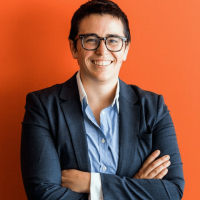
Alison Wendlandt – “Catalytic Isomerization Outside the Confines of Thermodynamics”
Massachusetts Institute of Technology
Alison Wendlandt is an Associate Professor of Chemistry at the Massachusetts institute of Technology. Alison is originally from Colorado, and received her B.S. from the University of Chicago and her Ph.D. from the University of Wisconsin – Madison under the guidance of Shannon Stahl. Alison was an NIH postdoctoral fellow at Harvard University in the Jacobsen research group, until beginning her independent career at MIT in 2018. The Wendlandt group is interested in the development and mechanistic elucidation of new selective catalytic reactions.
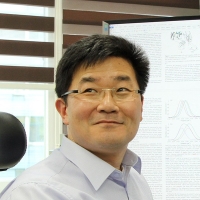
Mookie Baik – “The Electro-Inductive Effect”
Korea Advanced Institute of Science and Technology
Mu-Hyun “Mookie” Baik was born in Seoul, Korea, and raised in Germany, where he completed his undergraduate studies at the University of Düsseldorf. In 1996, he moved to the United States to pursue a Ph.D. in Chemistry at the University of North Carolina at Chapel Hill under the guidance of Professor Cindy Schauer. Following his doctoral studies, he conducted postdoctoral research at Columbia University in New York with Professor Rich Friesner. In 2003, he launched his independent academic career as an Assistant Professor in the Department of Chemistry at Indiana University and was promoted to tenured Associate Professor in 2008.
In 2015, Professor Baik returned to South Korea, where he now serves as an endowed Professor of Chemistry at the Korea Advanced Institute of Science and Technology (KAIST) and as the Associate Director of the Institute for Basic Science (IBS) – Center for Catalytic Hydrocarbon Functionalization. His research program integrates computational methods to elucidate the mechanisms of catalytic reactions mediated by organometallic reagents. Complementing his computational work, his laboratory conducts experiments that have led to the discovery of the “electro-inductive effect.” This innovative concept involves immobilizing reactive molecules on an electrode surface and using applied voltage to modulate electron density, rather than relying on traditional functional group modifications.
Professor Baik’s contributions to the field have been recognized with several prestigious awards, including the Cottrell Award (2006), NSF CAREER Award (2007), Sloan Fellowship (2007), Friedrich Wilhelm Bessel Award from the Humboldt Foundation (2018), and the TJ Park Prize from the POSCO Foundation in Korea (2021).
James McCusker – “Mechanistic Considerations in Photoredox Catalysis: The Potential Role of Metal-centered Ligand-field Excited States for Selective Photo-induced Synthetic Transformations in Organic Synthesis”
Michigan State University
Jim McCusker was born in New Haven, Connecticut in 1965. A graduate of Bucknell University (where he majored in Chemistry with minors in Physics and Music), Jim enrolled in the doctoral program at the University of Illinois at Urbana-Champaign in 1987 and carried out research in physical-inorganic chemistry under the guidance of the late Professor David N. Hendrickson. Jim was awarded a two-year post-doctoral fellowship from the National Institutes of Health in 1992 to work with Professor Thomas J. Meyer at the University of North Carolina, then began his independent academic career at the University of California at Berkeley as an Assistant Professor of Chemistry in the fall of 1994. The initial paper out of his group was the first application of femtosecond spectroscopy to understand the photophysics of an inorganic charge-transfer complex, specifically, a delineation of the ultrafast nature of excited-state evolution in [Ru(bpy)3]2+. While at UC-Berkeley, Jim was awarded the Department of Chemistry Teaching Award in 1999 in addition to being named an Alfred P. Sloan Fellow (1998 – 2000) and a Hellman Faculty Fellow of the University of California (1997 – 1998). Jim moved his research group to Michigan State University in 2001 where he is currently an MSU Research Foundation Professor of Chemistry. The central themes of his research group continue to focus on the synergy between synthesis and ultrafast spectroscopy to probe the light-induced properties of transition metal-containing molecules – in particular as they impact the development of solar energy conversion strategies and photoredox catalysis – as well as the interplay of spin, magnetism, and the excited-state dynamics of molecular systems.
An Associate Editor for Physical-Inorganic Chemistry at the Royal Society of Chemistry’s flagship journal Chemical Science since 2015, Jim has been recognized at Michigan State University with the 2014 Junior Faculty Mentoring Award, the 2016 College of Natural Science Outstanding Faculty Award, and the 2018 William J. Beal Outstanding Faculty Award by the President of Michigan State. He was named a Fellow of the Royal Society of Chemistry in 2016, was the recipient of the RSC Chemical Dynamics Award in 2020, the 2023 Inter-American Photochemical Society Award in Photochemistry, and most recently the 2024 Josef Michl ACS Award in Photochemistry. Jim has published over 100 articles in journals including Science, Nature, Chemical Science, and the Journal of the American Chemical Society, served as Chair of the 2012 Electron Donor-Acceptor Interactions and the 2023 Photochemistry Gordon Research Conferences, and has given in excess of 300 invited seminars at universities and conferences in more than 25 countries around the world.